

How to: Stay safe around power lines
6 September, 2024, by Ed Ewing | Photos: Marcus KingStaying alert to power lines is a key part of learning to fly XC – don’t let them catch you out when in the air or on the ground
The official incident report is brief, but it tells a story we can all recognise. “The pilot became aware of power lines when about to enter final approach to land. They changed their landing approach direction to avoid the hazard. They sustained minor injuries to their feet and legs landing with a tailwind.”
The pilot, who had 31 years’ experience and 690 logged hours, was flying a hang glider in calm conditions in June this year. Although the pilot suffered minor injuries they spotted the danger in time and avoided colliding with the high-voltage power lines.
If not fatal, the results can be life-changing. Today you can watch numerous videos of paramotors / paragliders / other aircraft hitting power lines on YouTube, but colliding with power lines is nothing new. In the mid-1990s doctors in Brisbane, Australia documented the case of two hang glider pilots who had hit power lines and suffered burns to their hands and abdomens as well as muscle damage and neurological injury – brain damage.
Not everyone is so lucky. Over the years numerous pilots of all sorts of low-flying aircraft have hit power lines, often with fatal results. The danger is ever-present: even when pilots are aware of power lines they can still hit them. A coroner’s report into an accident in England four years ago said the pilot came in to land in a field they were familiar with close to home. Known as a good, experienced and careful pilot who knew there were high voltage power cables present, on their final approach they were seen to “skim” a power line with their harness. Tragically, they were electrocuted and died at the scene.
There are numerous bar-room tales of pilots who have managed to get away with it. In our own archive they include a pilot who was electrocuted when he inflated his glider into a power line above. A pilot who survived a collision with a power line but then fell two storeys onto a “raging brush fire below” ignited by the sparks. A pilot in California who hit a power line carrying “enough power to light Las Vegas”. “Miraculously he staggered away alive.”
And that is the key word: miraculously. Unlike tree landings (“There are pilots who have, and pilots who will…”) if you hit power lines you need nothing short of a miracle to walk away. The key then is to avoid them.
The danger
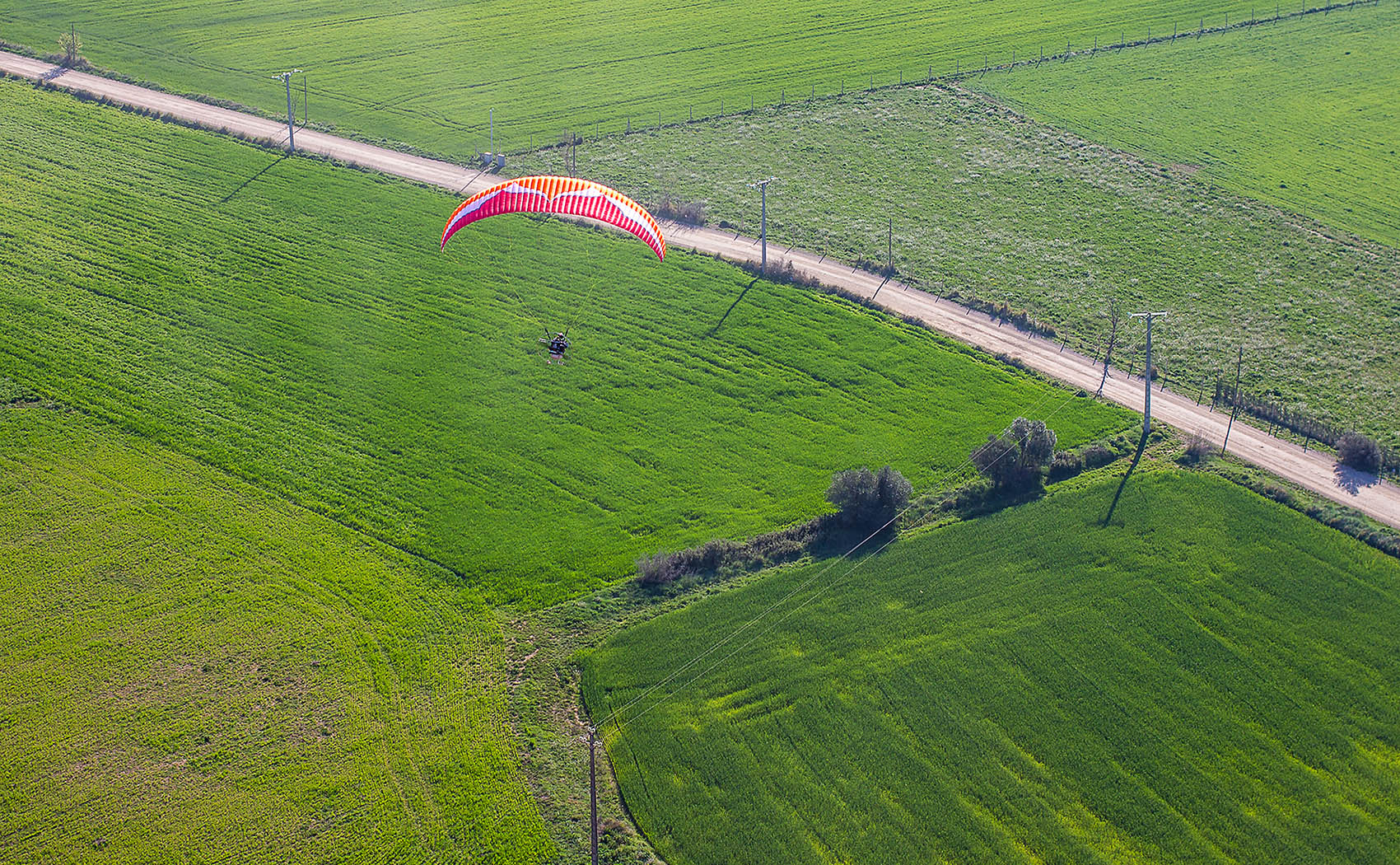
There are lots of different types of power lines, from single lines connecting an outbuilding to a house to the giant metal structures that stride across the landscape. All of them can be dangerous to low-flying pilots. Electricity systems carry voltages up to 765,000 volts (a car battery is 12 volts) and even 230 volts carried in a domestic system can be lethal.
Although some well-informed electrical engineers might be able to tell you what type of pole is carrying what voltage, this is irrelevant to pilots. The point is to avoid all electrical power lines, not play Russian Roulette with something you’re guessing “might be ok”.
To kill some misconceptions, wearing rubber boots will not protect you. Trees, ropes, suspension lines and water can all conduct electricity. Overhead power lines are often uninsulated (bare) and can carry high voltages: they can look like telephone wires, so never assume “it’s just a phone line”.
And even if you think electrical equipment is dead, if it has fallen or is broken for example, it is wise never to assume so: power can be switched back on at any time without warning. Last, touching anything in contact with electrical equipment, even at low voltages, can be fatal as electricity can jump gaps.
As always in flying we can start to minimise our risk by looking ahead and planning.
Before you fly
If you regularly fly from the same site make sure you know where any overhead power lines are. If you fly a new site make a point of looking at the club website or asking a local about any power lines near take-off, slung across the hill or near the landing. If you fly XC then get to know the power lines downwind too.
If you are flying a paramotor and intend to fly low then this is doubly important. Look at maps and air charts for where you intend to fly, and where you plan to land. Air charts often show the major transmission lines because of their height, but they do not show other low-voltage lines – notably those on wooden poles which are notoriously difficult to see from the air.
Check your instruments too. If you have an instrument with Flarm you can use the Flarm obstacle warning system for power lines, cable cars and antenna towers for many regions in Europe. XCTrack also features some power lines.
When standing on launch, especially one new to you, use your eyes to seek out pylons, poles, sub stations and large buildings. If you see one pylon then pause and look systematically for the next. They can be tricky to see, but if you get your eye in you will soon start to see them.
Link pylons or poles together and follow them: if they “disappear” that can mean they are simply stretched for a long distance, for example across a valley. Electricity cables are rarely buried in open country, stringing them from poles is much, much cheaper.
Lastly, always carry a mobile phone with you in an accessible place.
During your flight
Power lines can be hard to spot from the air. They usually become a problem when we are low: they can be strung across the hillside we are soaring; across the exit to a side valley we’re trying to get out of; or criss-crossing the landing field. It helps if we can spot them when we are higher – this gives us time to avoid them.
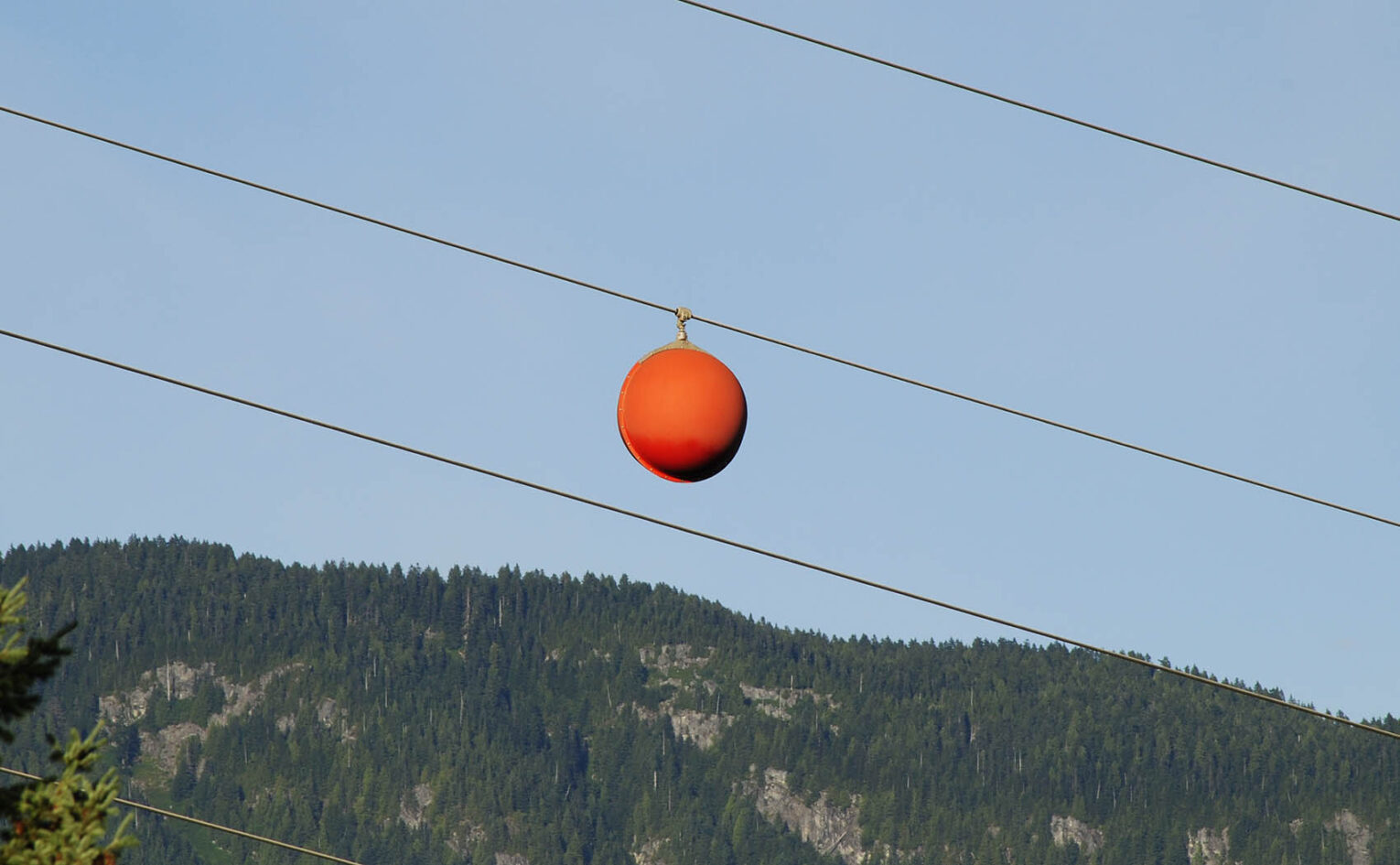
To do this, first look for the pylons, poles or visibility balls – they are easier to see. Then connect the dots: that’s where the power lines will be. In early and late afternoon look for the shadows of the poles, which will extend across the ground and be more obvious. At midday, with the sun high above, shadows will be shorter or non-existent and therefore harder to see.
Secondly, look for the glint or reflection of the metal poles and lines. You are more likely to notice this if you change angle, eg while you are thermalling or turning.
Think about power lines as the norm. Expect them to run along every road and lead to every building. Look for power lines where you see a cut in the trees, or overgrown grass. Look at your landing field from different angles and keep looking at it as you get lower. If you see a solitary building in a field, then expect a power line going to it somewhere: often they connect at the corners of buildings.
Be aware that smaller, less visible lines are often placed above or below larger lines; don’t ever consider trying to fly under large, high-tension power lines. Smaller power lines also often come off larger power lines at right angles.
It should go without saying, but it really helps if you can see sharply. If you wear glasses keep your prescription up to date. Experiment with yours to see how you see things like poles and power lines; you might get a clearer view if you lift them up.
Landing
When flying XC the general rule is always to have a landing option in mind. As you climb higher you get more options, as you get lower your options decrease. When assessing landing options as you fly – “I can land there, that looks ok…” – make it part of your assessment to check for power lines.
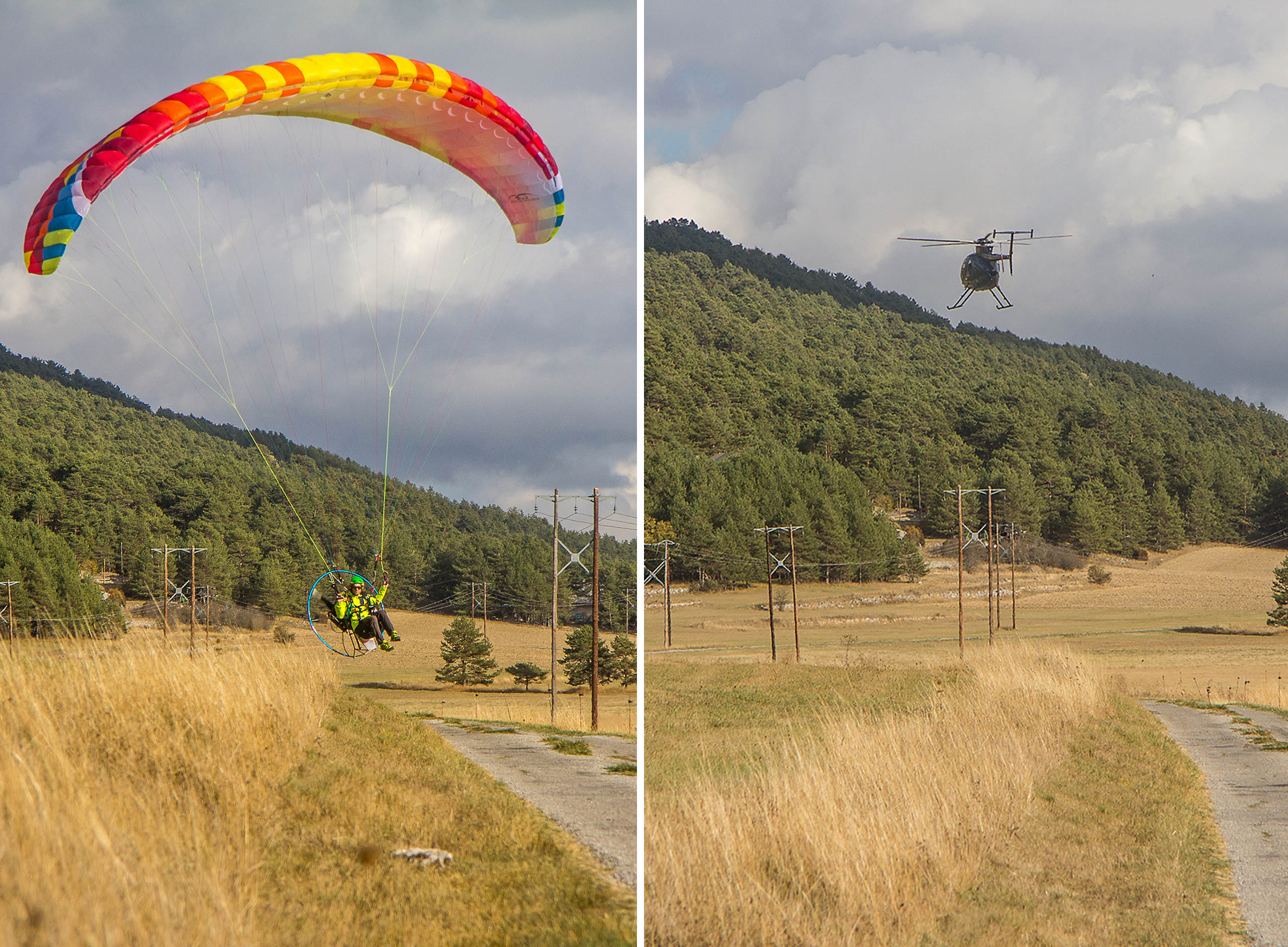
Electricity companies use low-flying helicopters to survey their pylons – these photos were taken just a few minutes apart
If your chosen field does have a power line in it or near it then choose an approach that gives you the longest, clearest amount of runway, preferably with space to overshoot, too. This might mean landing crosswind, and that is ok.
If the power line is at the end of your field and you are landing towards it, then aim to land in the first third. This gives you room to overshoot. If the power line is at the back of the field and you are landing away from it, then aim to land in the second two-thirds so you don’t come in low over the power line. If it runs along the left side of the field then land in the right, and vice versa.
Position yourself so you do not have to make your final into-wind turn or approach low across a power line. Keep the power line behind you as you lose height and do not turn into it or behind it; you do not want to sink out in the turn and descend onto the top of it. Be especially aware of this if it is windy or you are coming down into a stronger valley wind.
If you get stuck above a power line in strong wind and you feel you are descending onto it then act quickly: either accelerate (hands up, push bar) to move forwards; or look behind you over your shoulder and see what the downwind option is. You might have to just turn and land downwind, like the example used at the top of this article. Be aware this will be fast, but it is infinitely better than landing on a power line.
If the choice is between hitting a power line or a tree, then land in the tree every time.
What to do in an emergency
If you hit an overhead line, get hung up in one, or see someone hit one, here’s what to do:
- Assume the line / wires are live, even if they are not sparking
- Remember that, even if they are dead, the wires can become live again with no notice. This may happen automatically after a few seconds, or may be re-energised remotely up to several hours later if the electricity company is not aware that the line has been damaged
- If you can, use your mobile phone to call the emergency services. Give them your location as accurately as you can. Send them a pin or use an app like WhatThreeWords to provide an accurate location. Tell them there are electrical wires involved and ask them to inform the electricity company
- If your glider is in contact with an electrical wire or within five metres of a damaged overhead wire, then stay attached until the emergency services or electricity company arrive, unless there is a real threat of fire
- Once a wire is on the ground you do not have to touch it to be killed. The current may travel a significant distance through the ground and even further if the wire has fallen on a fence or other metallic objects. Be aware, keep clear
- If you have to get out of your harness, then try and jump clear rather than stepping off onto the ground. Use long bounding steps to move rapidly at least 10 metres away
- Emergency services in western countries are trained in how to undertake rescues close to damaged overhead lines.
- An electrical engineer will confirm when the power has been turned off and the rescue can proceed safely
- If suspended from, or tangled in wires, do not allow others to approach until it is confirmed safe to do so by the electricity company
- Always ring the emergency services and through them the power company: do not try to self-rescue equipment out of power lines.
Source: UK Power Networks
This article was first published in Cross Country 252